What is lead qualification?
Lead qualification is deciding whether a lead is worth a salesperson's time, and how soon. On a first call it comes down to a yes or no: book a meeting, or don't.
It matters because a meeting with a poor-fit lead costs a closer's hour and produces nothing, and a lead who was never a fit has little reason to turn up in the first place. Tight qualification protects both your closers' calendars and your close rate.
What should you learn on a qualification call?
Four things, and only as much of each as you need to decide whether to book.
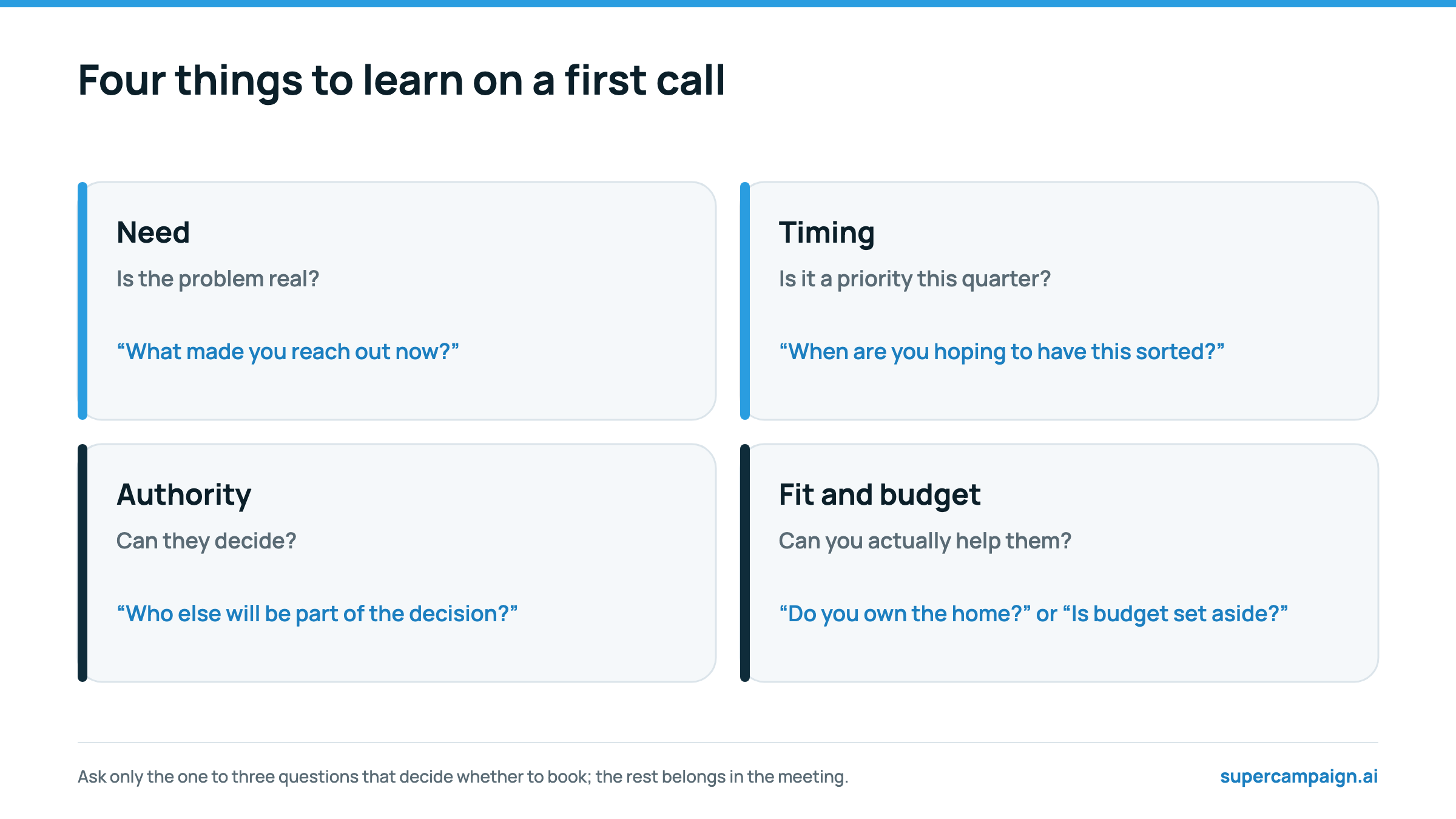
Need: is the problem real?
- What made you reach out now?
- What's happening today that you'd like to change?
- What have you tried so far?
Timing: is it a priority now?
- When are you hoping to have this sorted?
- Is there a date driving this, like a launch, a renewal or a move?
- If we found the right fit, would you want to start this month or later in the year?
Authority: can they decide?
- Who else will be part of the decision?
- Would it make sense to invite them to the call with our adviser?
Fit and budget: can you actually help?
- The knockout question for your business: do you own the home, are you in our service area, how many staff do you have?
- Is there a budget set aside for this, or are you still working that out?
Note the phrasing. “Who else will be part of the decision?” assumes others may be involved, which is easier to answer honestly than “Are you the decision-maker?”, a question almost everyone answers yes to.
BANT, CHAMP, ANUM and MEDDIC: which framework should you use?
Sales teams use acronyms to make sure no dimension gets skipped. They overlap heavily.
| Framework | Stands for | Best for |
|---|---|---|
| BANT | Budget, Authority, Need, Timeline | Simple, high-volume qualification; the most widely known |
| CHAMP | Challenges, Authority, Money, Prioritization | Leading with the lead's problem rather than their budget |
| ANUM | Authority, Need, Urgency, Money | Sales where reaching the decision-maker is the main hurdle |
| MEDDIC | Metrics, Economic buyer, Decision criteria, Decision process, Identify pain, Champion | Complex B2B deals with several stakeholders; usually too much for a first call |
For a setter's first call, a light CHAMP order works best: start with the challenge, because it gets the lead talking about themselves, then timing, then authority, then fit. Leave MEDDIC-level detail to the account executive.
How many qualification questions should you ask?
One to three on a setter call, plus your knockout question if you have one. Each extra question costs attention, and the lead booked a call to talk to an expert, not to fill in a form by voice.
A useful test for every question on your list: if the answer would not change whether you book the meeting, move it to the meeting.
Lead qualification questions by industry
| Industry | Knockout question | Qualifying questions |
|---|---|---|
| Solar | Do you own the home? | Roughly what is your monthly electric bill? How old is the roof? |
| Roofing | Is the property in our service area? | What's prompting the call, damage, age or a sale? Is an insurance claim involved? |
| Real estate | Are you buying, selling, or both? | When are you hoping to move? Have you spoken to a lender yet? |
| Insurance | Which state is the policy for? | What type of cover are you looking for? When does your current policy renew? |
| Coaching | Do you run your own business? | What does it make a month today? What's the main thing you want to fix? |
| Agencies | Do you have a marketing budget each month? | What are you running today? What result would make this a win? |
| B2B software | How many people would use it? | What are you using now? When does that contract end? |
Insurance agents should check licensing before qualifying: you can only quote where you hold a licence, which makes the state a knockout question.
How to turn answers into a booking decision
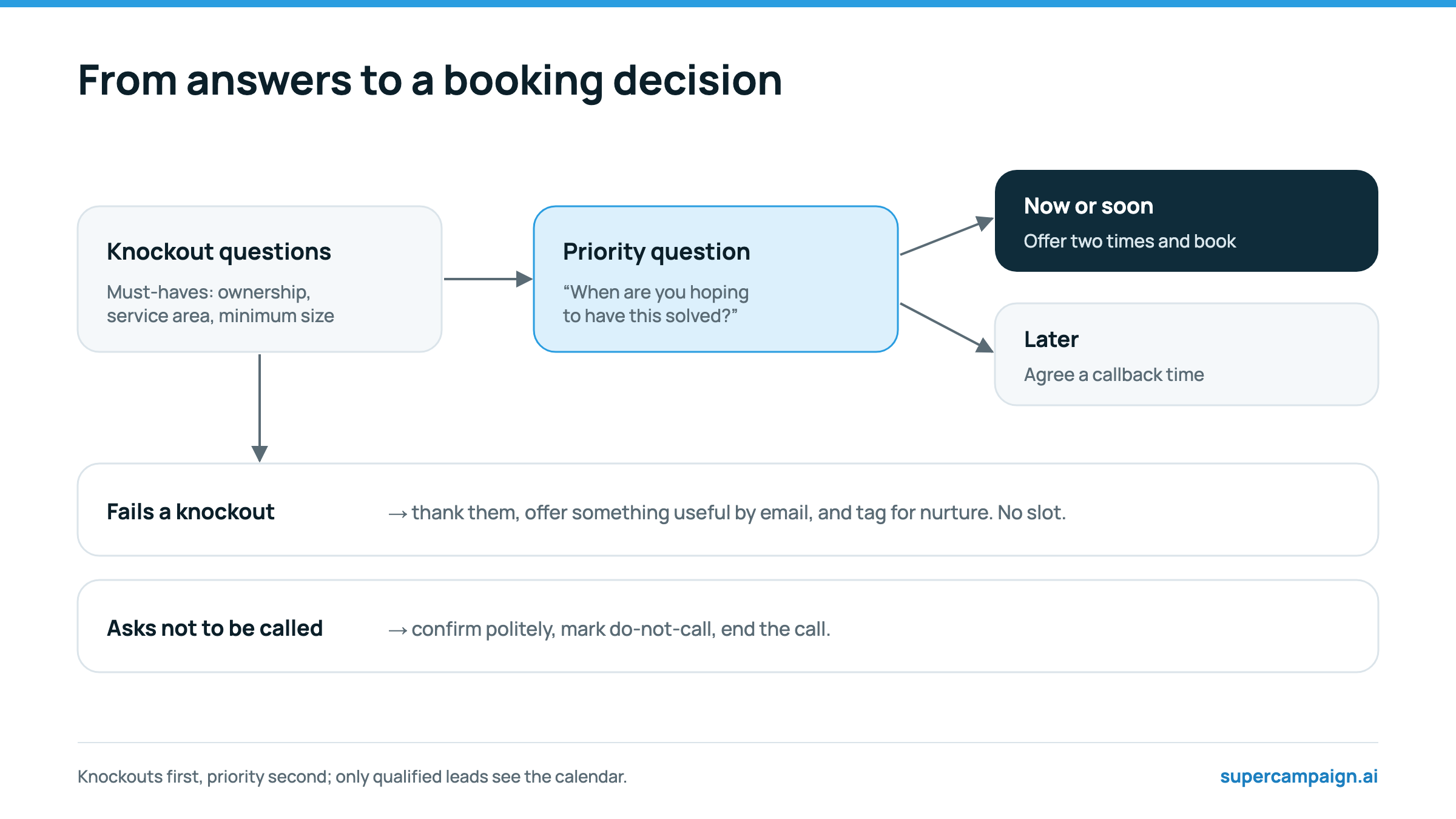
- Ask the knockout question. If the lead fails it, you cannot help them; do not book.
- Ask the need and timing questions. Strong need plus near-term timing means book now.
- If the need is real but the timing is months away, agree a time to call back rather than booking a meeting that will be cancelled.
- If authority is unclear, book anyway, and ask the lead to invite the other decision-maker.
Write these rules down. A setter, human or AI, with explicit rules books more consistent meetings than one working from instinct.
How to score leads from their answers
If you get more qualified leads than your closers can take, or several setters need to make the same call the same way, a simple points model helps. Keep it to a handful of criteria you actually hear on the call.
| Criterion | Answer | Points |
|---|---|---|
| Knockout | Fails it | Do not book, whatever the score |
| Need | Describes a specific, current problem | 3 |
| Timing | Wants it solved within 30 days | 3 |
| Timing | Within 90 days | 1 |
| Authority | Decides alone, or will bring the other decision-maker | 2 |
| Budget | Has a budget, or the knockout implies one | 2 |
Revisit the thresholds after a month. Compare the scores of leads who closed with those who didn't, and move the line to where the difference is.
Which qualification questions should you avoid?
- “Are you the decision-maker?” Almost everyone says yes. Ask who else is involved instead.
- “What's your budget?” as the first question. It feels like a price check before you have shown any value.
- Questions the form already answered. Read the form first and confirm rather than re-ask.
- Leading questions such as “You'd agree that growth is important, right?” They irritate people and tell you nothing.
- Anything you won't use. If an answer would not change whether you book, leave it for the meeting.
How to disqualify a lead politely
Disqualifying is a service. The lead learns quickly that you are not right for them, and you keep a good impression for later.
Thanks for being so open about that. Honestly, based on what you've said, we're probably not the right fit right now; our program works best for businesses already making over $20,000 a month. I'll email you a free guide that covers the first steps, and if things change, we'd love to hear from you.
Then actually send the email, and keep the lead in your nurture list. Many leads that are too early today become a fit within a year.
Asking qualification questions with an AI voice agent
An AI appointment setter can run this logic on every call, at any hour inside your calling window. Three things make it work:
- Put the knockout and booking rules in the prompt in plain language: “Only offer times if the caller owns the home and the bill is over $100 a month.”
- Tell the agent to ask one question at a time and to confirm what it heard before moving on.
- Give it calendar tools so a qualified lead is booked on the call, and a clear script for leads who do not qualify.
In SuperCampaign, the agent books qualified leads on Calendly, Google Calendar or iClosed during the call. Every call's outcome and a summary of the conversation land on the contact's timeline, with the full transcript in the run. A workflow can then check whether a meeting was booked and tag everyone else for nurture.