What is an AI appointment setter?
An AI appointment setter is a piece of software that does the job a human appointment setter, or SDR, does at the top of the funnel: it gets in touch with a lead, checks whether they are a fit, and books a meeting with the person who will sell to them.
There are three kinds, and the word is used for all of them:
- Chat and DM setters reply to messages on Instagram, Facebook, WhatsApp or a website chat widget, and share a booking link.
- SMS setters run a text conversation and book a time over text.
- Voice setters place a phone call, hold a spoken conversation and book the meeting while the lead is still on the line.
This article is mostly about voice setters, because that is where the technology changed most recently and where the speed advantage is largest. A phone call reaches a new lead while they are still thinking about you; a text or an email waits in an inbox.
How does an AI appointment setter work?
On every call, three AI components work in a loop: speech recognition turns what the lead says into text, a language model decides what to say next, and a text-to-speech voice says it. A platform such as Vapi, Retell AI or Bland AI runs that loop and connects it to a phone line.
What turns a talking agent into an appointment setter is tools: small functions the agent can call mid-conversation to check which times are free on Calendly, Google Calendar or iClosed, and to create the booking once the lead picks one.
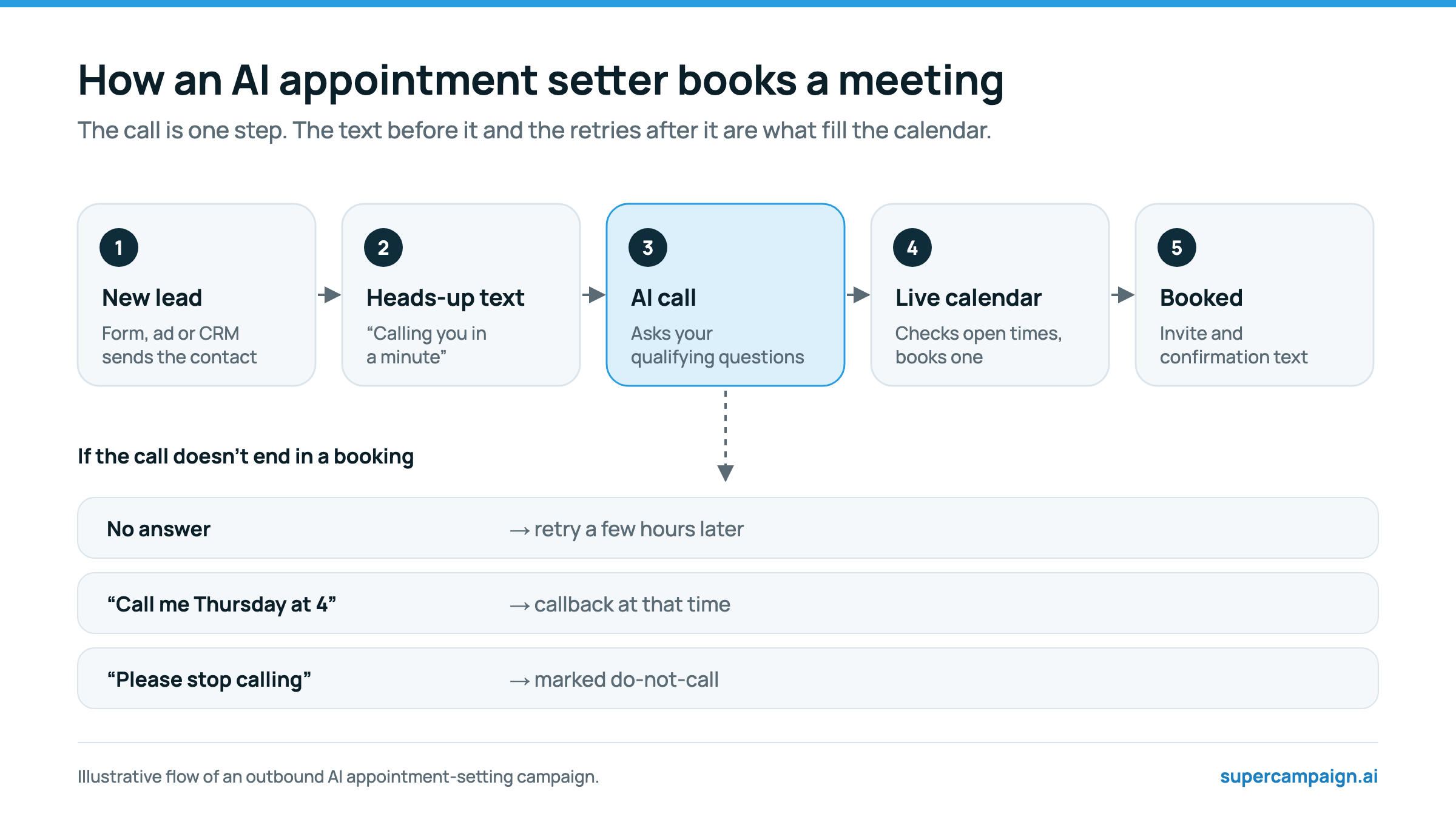
A complete outbound setter runs in this order:
- A lead arrives: a form fill, an ad lead, a CRM tag or a row in an imported list.
- A short heads-up text tells them a call is coming, so they recognise the number.
- The AI calls, says who it is and that it is an AI assistant, and asks one to three qualifying questions.
- If the lead is a fit, the agent checks live availability, offers two times and books the one they choose.
- The lead gets the calendar invite and a confirmation text. If nobody answered, the call is retried later; if the lead asked to be called back at a certain time, the call goes out then.
Steps 2 and 5 are where most of the difference between setters lies. Many voice platforms handle the conversation well and leave the campaign logic, who gets called when, how often and what happens next, to you.
What can an AI appointment setter do well, and what can't it?
Where it is strong
- Speed. It can call a new lead within a minute, every time, including the evening rush when your team has gone home but the lead is still in calling hours.
- Coverage. Every lead is called, not only the ones a busy person reaches. Retries and callbacks happen without anyone remembering them.
- Consistency. The same script, the same disclosure and the same calendar rules on every call, and a transcript of what was said.
- Repetitive calls. Confirmations the day before, no-show follow-ups and old-lead reactivation are the same conversation hundreds of times, which people find tedious and skip.
Where it falls short
- Conversations that leave the script. Complex deals, upset customers and unusual situations still need a person.
- Rapport in high-ticket sales. In coaching and consulting, the setter is often the first person the buyer trusts.
- Leads without consent. A person dialling by hand has a lower legal bar than an AI voice in the United States.
- Closing. The setter books the meeting. A person still runs it.
The pattern most teams settle on is a hybrid: the AI makes the fast, repetitive calls and hands a person a list of leads it could not book, each with a summary of what was said. The trade-offs are covered in AI appointment setter vs human setter.
How much does an AI appointment setter cost?
Pricing comes in four shapes. All figures below are from each vendor's own pricing page in October 2026.
| Pricing model | Example | What you pay |
|---|---|---|
| Bundled per-minute rate | Bland AI | $0.14 a minute, or $0.12 a minute plus $299 a month; telephony separate |
| Pay as you go, all-in | Retell AI | $0.07 to $0.31 a minute depending on model and voice; 20 concurrent calls included |
| Platform fee plus provider costs | Vapi | $0.05 a minute hosting, plus model, speech, voice and telephony at provider rates |
| Annual contract | Synthflow | Enterprise contracts from $30,000 a year |
For a sense of scale, take 2,000 minutes of calls a month. At published rates that is roughly $140 to $620 on Retell AI and about $190 to $290 on Vapi with Twilio. A full-time human setter in the United States earns about $4,200 a month at ZipRecruiter's average of $24.26 an hour, before payroll costs.
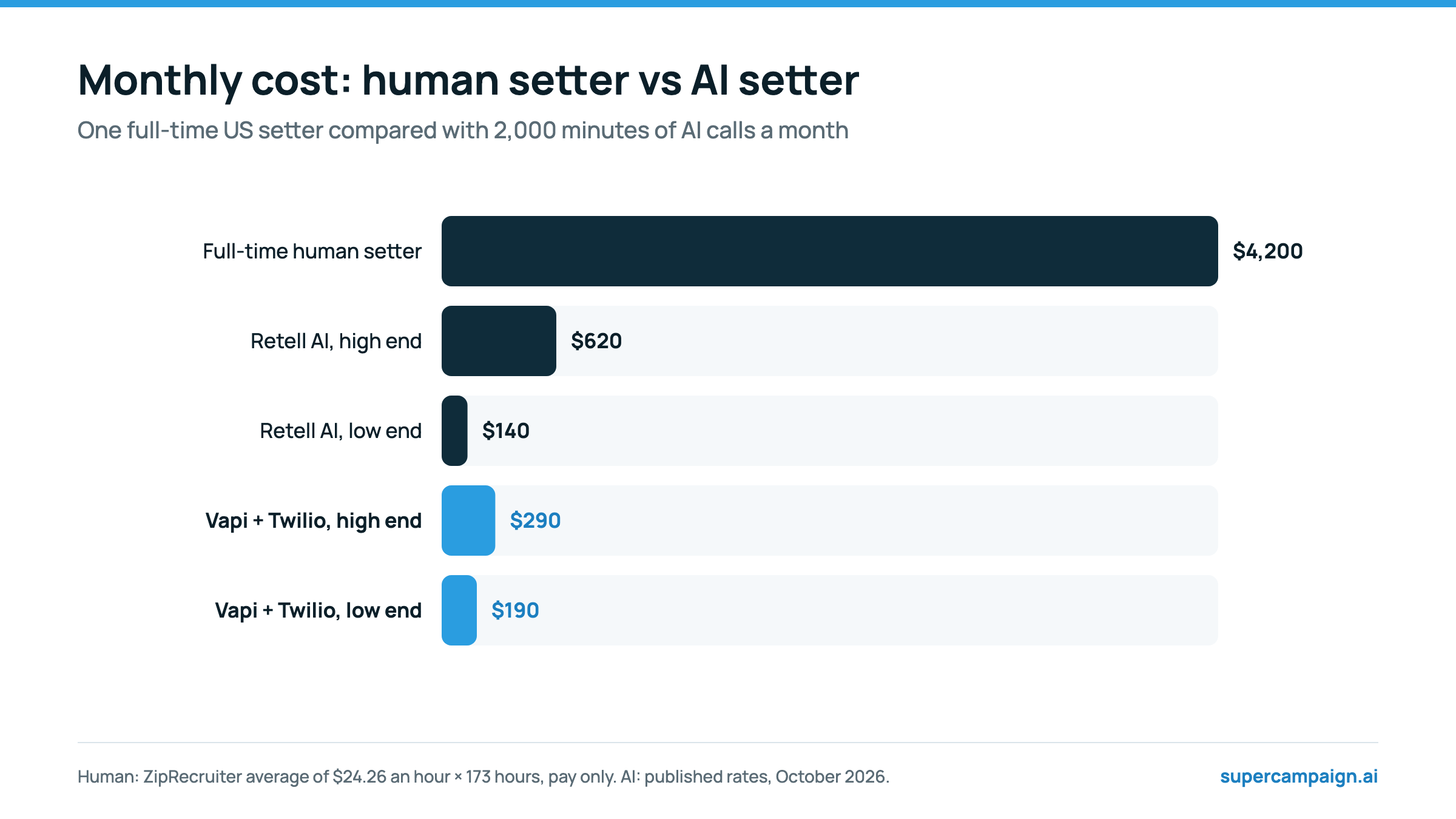
Two caveats keep that comparison honest. First, the minutes are not the only cost: someone has to write the script, read the first transcripts and collect the consent the calls require. Second, the useful comparison is cost per meeting held, not per month, because a booking that does not turn up costs you a slot either way.
SuperCampaign pricing: a free plan, and no markup on your providers
Is it legal to use an AI appointment setter?
Yes, with the right consent. In February 2024 the FCC confirmed that AI-generated voices count as artificial voices under the Telephone Consumer Protection Act. In practice, a marketing call from an AI voice to a mobile phone needs the person's prior express written consent: a ticked box on your form that clearly covers automated or AI calls from your business is the usual way to get it.
The call must also identify your business at the start, happen within calling hours, which are 8 am to 9 pm in the lead's time zone federally and stricter in some states, and honour every opt-out. This is a summary, not legal advice.
When should you use an AI appointment setter?
It earns its keep where speed or volume matters more than nuance. Five campaigns account for most of the value:
- Speed to lead: call every new form fill within a minute, while the lead is still at the screen.
- Booked-call confirmation: confirm each meeting by voice the day before.
- No-show recovery: call people who missed a meeting within minutes and rebook them.
- Callbacks: call back at the exact time a lead asked for.
- Database reactivation: work through old leads who agreed to be contacted.
If your leads mostly arrive through Instagram DMs, a chat setter fits better. If you get few leads and each is worth a lot, a skilled person may still be the better first hire.
How to choose an AI appointment setter
Six questions separate the options quickly:
- Does it book on your calendar during the call? Check for your exact tool: Calendly, Google Calendar, iClosed, GoHighLevel or Cal.com.
- What happens when nobody answers? Look for retries on a schedule and callbacks at the time the lead asked for, not just a single attempt.
- Can it start from your lead sources automatically, through an API, a webhook or a CRM, without a person uploading lists?
- What guardrails are built in: calling hours, opt-outs and automatic do-not-call when someone asks to stop?
- How is it priced, and does the price include the model, voice and telephony or pass them through?
- Can you read what happened on every call, with an outcome, a summary and the transcript?
If you also need inbound calls, certifications such as SOC 2 or HIPAA, or native CRM sync, weigh those first; they rule tools in or out faster than anything else. Our list of Synthflow alternatives compares the main platforms on these points.
How to set one up in an afternoon
With SuperCampaign, which runs AI appointment-setting campaigns on your own Vapi and Twilio accounts, the setup is five steps:
- Connect your Vapi account, your Twilio number and your calendar.
- Write the agent's script in plain language and attach the calendar tools.
- Draw the campaign: the trigger, a heads-up text, the AI call, a check for an existing booking, a retry and a follow-up.
- Set calling hours and test on your own phone.
- Publish, and read the first twenty calls before you send more traffic.
Sources
Reviewed on 19 October 2026. Vendor figures are the vendor's own and have not been independently audited.