What is a normal no-show rate for sales calls?
There is no single industry figure, because companies count no-shows differently. The most transparent public dataset is RevenueHero's December 2024 benchmark: 419 no-shows across 6,428 scheduled B2B meetings, or 6.5%. The spread between industries is wide, from no no-shows in healthcare to 15.1% in real estate and 18.1% in education and e-learning.
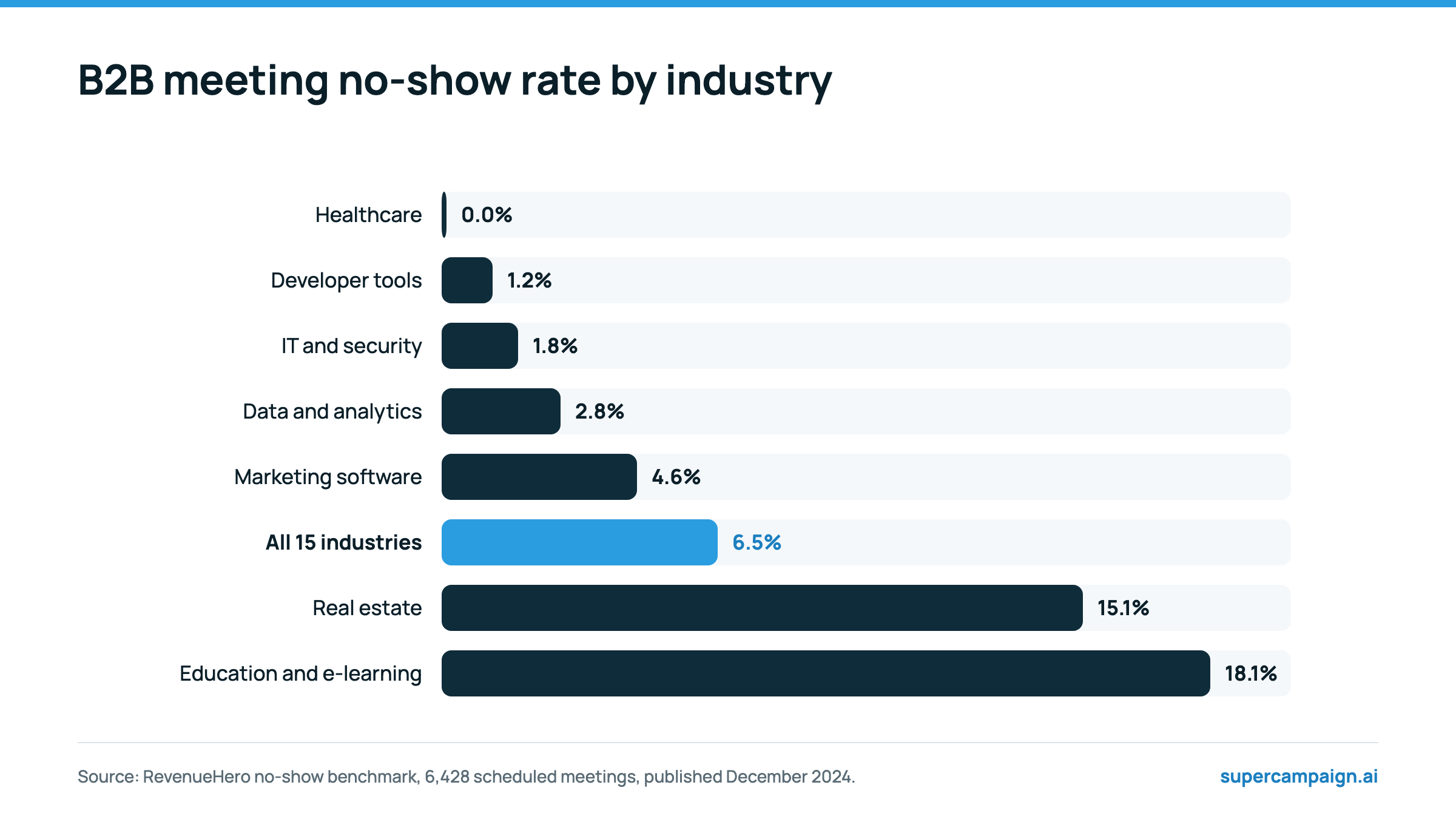
A separate RevenueHero analysis of 18 weeks of meeting data from its customers found an average no-show rate of 15.9% and a median of 13.5%, with the best tenth of teams at 5.5%. Both datasets come from teams using an instant scheduler, which tends to keep rates low. If your meetings are booked days out by a setter, expect your number to be higher.
The practical point: measure your own rate before you change anything. Count meetings held divided by meetings booked, by lead source, and you will know which part of the funnel to fix.
Why do prospects no-show?
Almost every no-show comes down to one of six causes:
- They forgot. The meeting was booked days ago and nothing reminded them.
- They lost interest. The urgency that made them book has faded by the time the meeting arrives.
- Something came up, and moving the meeting looked harder than skipping it.
- They never really committed. Someone else booked the time for them, or they booked to get rid of a persistent caller.
- They could not find the link, or the time zone was wrong.
- They did not know why the meeting was worth their time.
Each tactic below targets one or more of these. Notice how few of them are about persuasion: most are about timing and friction.
Before the meeting is booked
1. Offer times in the next few days, not the next few weeks
Lead time is the strongest predictor of a no-show. RevenueHero notes that show rates drop sharply once a meeting is more than three days out, and Calendly recommends showing outbound prospects only the next five days and giving inbound leads two to three days to book. If your closers are fully booked for two weeks, that is a capacity problem, and adding reminders will not fully fix it.
2. Qualify before you book
People who are not a fit are the least likely to show. One or two questions before the calendar appears, such as budget, timeline or role, keep those people off it.
3. Let the prospect choose the time
A time the prospect picked is a time they own. Offer two specific options or a scheduler, rather than sending an invite for a time you chose.
Right after the booking
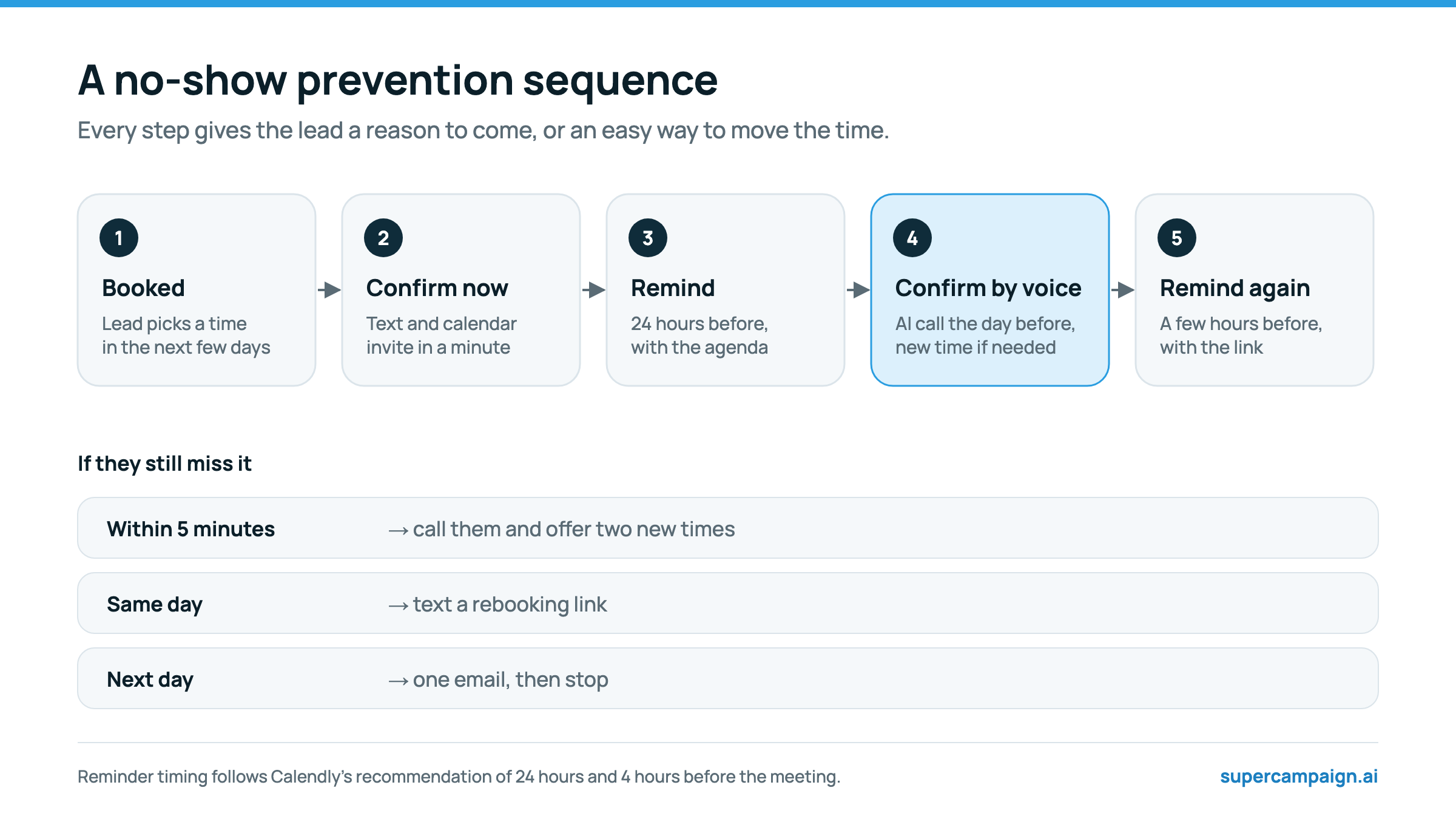
4. Confirm within a minute, by text and invite
Send the calendar invite and a short text while the prospect is still on your site: the time in their time zone, who they are meeting, and one line about what they will get out of it.
5. Give them a reason to come
Send one useful thing before the meeting: a short agenda, a relevant case study, or two questions to think about. Calendly suggests a high-level agenda covering the prospect's challenges and the meeting flow. It makes the meeting feel like it is about them.
Before the meeting
6. Remind 24 hours and a few hours before
Automated reminders are the cheapest fix. Calendly reports that its sales users saw no-show rates fall by 28% on average with automated reminders, and recommends one reminder 24 hours before and another four hours before. That figure is vendor-reported and several years old, but the direction is consistent with everything else published on reminders.
7. Confirm by voice the day before
A short call the day before does what a reminder cannot: it gets a yes, or it surfaces the conflict while there is still time to move the meeting. That works only if the caller can book a new time on the spot. This is a natural job for an AI confirmation call, because it is the same 40-second conversation every time and nobody on the team wants to make fifty of them.
8. Make rescheduling one tap
Put a reschedule link in every reminder. A prospect who moves the meeting is a meeting saved; a prospect who cannot see how to move it often just does not turn up.
What should a meeting reminder say?
A reminder has four jobs: say when, say with whom, give a reason to come, and make moving the time easy. Anything more gets skimmed. Keep the text to two or three short sentences and put the link last.
Hi {{contact.firstName}}, a reminder that you're speaking with Marcus from Northstar tomorrow at 2:30 pm. He'll walk through your numbers and what a realistic plan looks like. Need a different time? Reschedule here: [link]
See you at 2:30 pm today, {{contact.firstName}}. Here's the link to join: [link]. Need to move it? Use this: [link]
Two details matter more than the wording. Show the time in the lead's time zone, not yours, and test that every link opens on a phone, because most reminders are read on one.
After a no-show
9. Call within five minutes and rebook
Most no-shows are not rejections. The prospect got pulled into something else and feels mildly guilty about it. A call within minutes of the missed start, along the lines of “Looks like today got away from you, want to grab tomorrow at the same time?”, catches them while they still remember why they booked. The same message as an email the next day is far easier to ignore.
10. Follow up twice, then stop
If the call does not reach them, send a text with a rebooking link the same day and one email the next day. After that, stop. Chasing harder rarely rebooks anyone and often earns an opt-out.
Calls to people who missed a meeting are still marketing calls. In the United States, an AI-voice call to a mobile needs the person's prior written consent, usually collected on your booking form. See Is AI cold calling legal?
How to measure your show rate
Track show rate, meaning meetings held divided by meetings booked, weekly and split four ways. Each split points at a different fix.
| Split by | What it tells you | Typical fix |
|---|---|---|
| Lead source | Which channels book people who never meant to come | Qualify that source harder before booking |
| Lead time | How fast intent decays between booking and meeting | Offer earlier times; add capacity |
| Day and time | Slots people consistently miss | Remove them from the scheduler |
| Reminder path | Whether people who confirmed by voice show up more | Extend the confirmation call to every meeting |
Give any change two to four weeks before judging it; one week of meetings is too few to see a real difference.
How to automate the whole sequence
Tactics 4 to 10 are timing rules, which makes them easy to automate. In SuperCampaign they run as two campaigns on your own Vapi and Twilio accounts:
- Booked-call confirmation: a new Calendly booking starts the workflow, a text confirms it straight away, and after a wait you set to match your usual lead time, such as 20 hours for meetings booked a day or two out, an AI call confirms the time or books a new one.
- No-show recovery: a cancellation in Calendly, or a no-show tag your closer or CRM adds, starts a call within minutes that offers two new times and books one.
Every call is logged with its outcome and a summary on the contact, so your closers can see who confirmed before the day starts.
Sources
Reviewed on 19 October 2026. Vendor figures are the vendor's own and have not been independently audited.