What is speed to lead?
Speed to lead is how quickly you make first contact with a new lead after they reach out. The clock starts when someone fills in a form, requests a quote, books a demo, or replies to an ad, and stops at the first real conversation, which usually means a phone call. An automated “thanks, we'll be in touch” email does not count.
It matters because interest is perishable. The moment someone submits a form is the moment they are most likely to answer the phone and most likely to remember why they asked. Every hour after that, they get busier, compare other options, or forget.
What does the research say about lead response time?
The 2007 Lead Response Management study
The most-cited work on speed to lead is the Lead Response Management study by James Oldroyd, then at MIT, using data from InsideSales.com. It analysed three years of data from six companies: more than 15,000 web leads and more than 100,000 call attempts.
- The odds of qualifying a lead fell 21-fold when the response time stretched from 5 to 30 minutes.
- The odds of reaching a lead at all fell more than tenfold within the first hour.
- Wednesday and Thursday were the best days to make contact; 4 to 6 pm was the best time to reach people, and 8 to 9 am and 4 to 5 pm the best times to qualify them.
Two caveats. The data is from the mid-2000s and six companies, and InsideSales sold dialing software. You will often see the study quoted as “100 times more likely to reach a lead”; the study's own summary says “more than tenfold” within the first hour, so treat bigger numbers with suspicion. The direction, though, has held up in everything published since.
The 2011 Harvard Business Review follow-up
In a 2011 Harvard Business Review article, “The Short Life of Online Sales Leads,” Oldroyd and colleagues audited how quickly companies responded to web enquiries. Their headline finding was blunt: most companies are not responding nearly fast enough.
What companies do today
Not much has changed. In March 2024 RevenueHero submitted a demo request to 1,000 B2B SaaS companies and timed the replies. Only 172 replied in under two minutes, and those counted automated emails. 635 never replied at all. The 365 that did took an average of 1 day, 5 hours and 17 minutes.
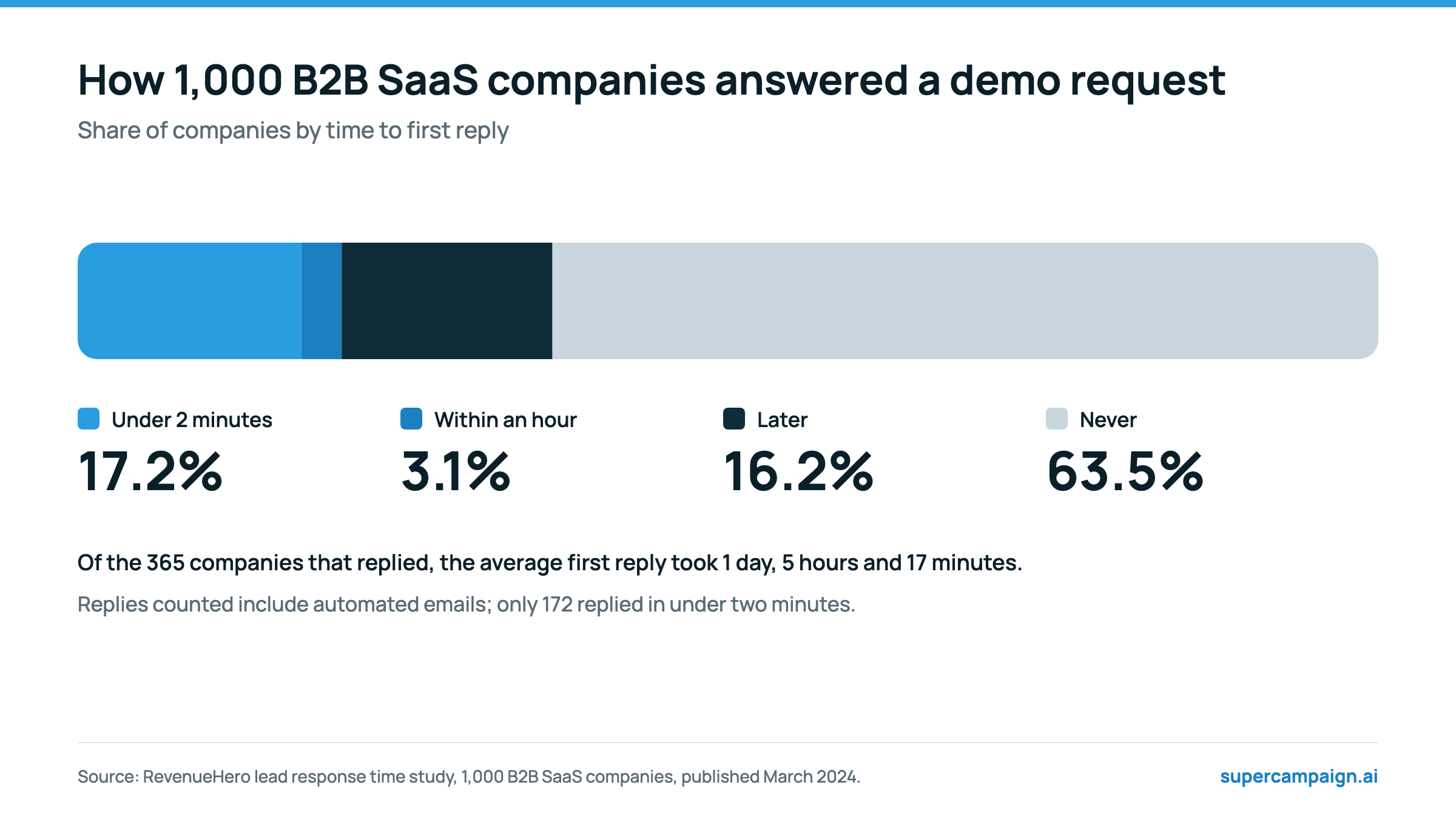
That is the opportunity in one chart: a team that calls within a minute is competing against companies most of which never call back at all.
Why do the first few minutes matter so much?
- The lead is still at the screen, often with their phone in hand.
- They remember exactly what they asked for and why, so the conversation starts warm.
- They have not yet heard from a competitor. The first company to have a real conversation usually sets the terms of the comparison.
- A call that arrives while intent is high gets a qualifying conversation; a call that arrives a day later gets voicemail.
What is a good speed-to-lead time?
| Response time | Verdict | What it takes |
|---|---|---|
| Under 1 minute | Best in class | Automation: the lead reaches your calling system instantly and a call goes out on its own |
| Under 5 minutes | Good | A person watching for new leads, or automation |
| 5 to 30 minutes | Weak | Leads handled in batches between other work |
| Hours or days | Most companies | Leads wait for the next shift, or a CRM sync that runs every few hours |
Five minutes is achievable for a person during working hours. One minute, consistently, including evenings and weekends inside calling hours, realistically needs automation.
How to reach every lead in about a minute
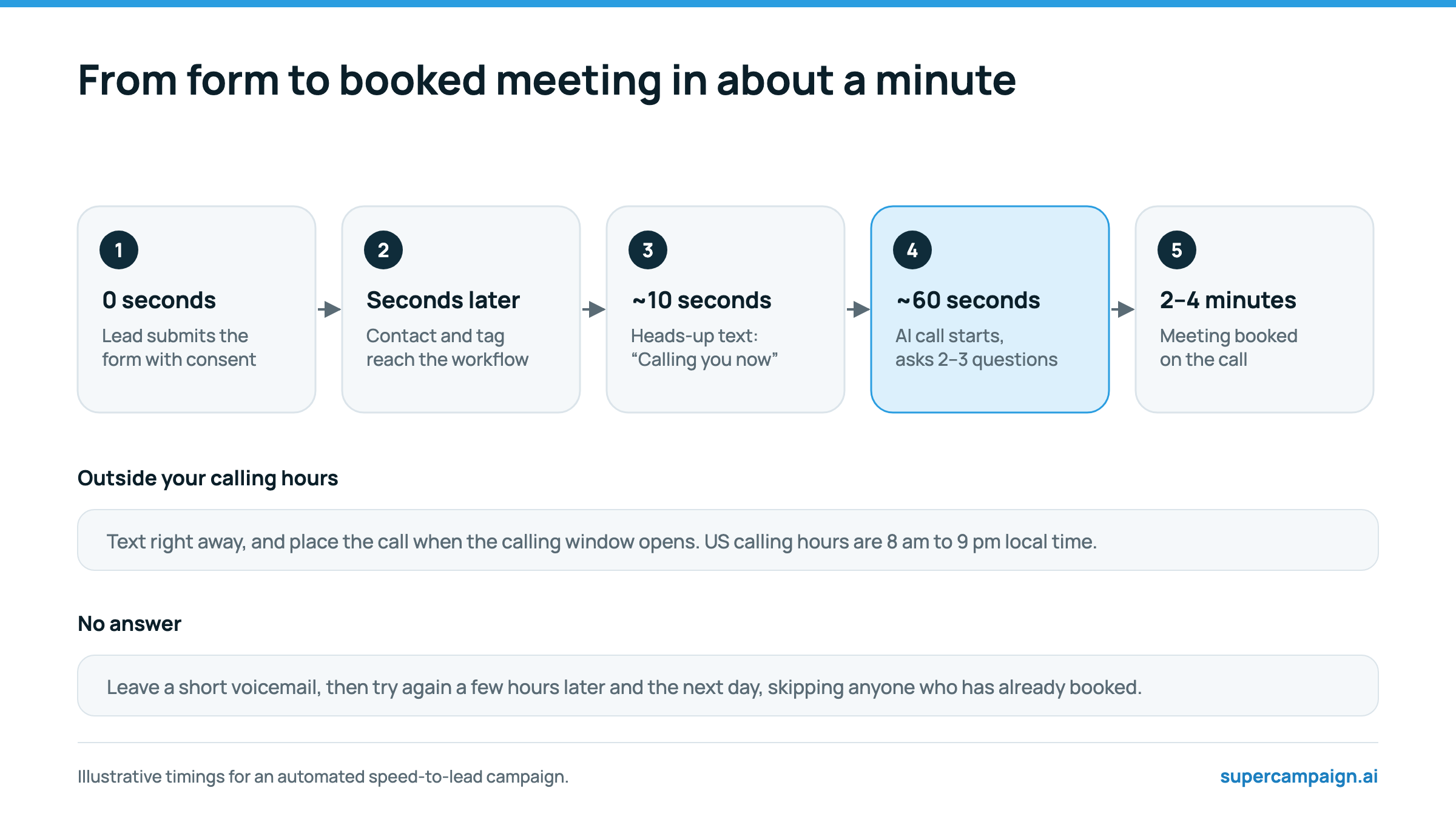
- Collect consent with the phone number. In the United States, AI-voice marketing calls to mobiles need prior express written consent, so the form needs a clear checkbox. See Is AI cold calling legal?
- Send the lead straight to the system that calls, by webhook or API, not through a CRM sync that runs every hour.
- Text first. A short text that names your business, such as “It's Riley from Northstar, calling you in a minute about your enquiry”, means the call that follows is expected rather than a stranger's number.
- Call within a minute, with a script that names what the lead asked for in the first sentence.
- Book on the call. The caller, human or AI, should be able to check live availability and book a time before hanging up.
- Retry and call back. If nobody answers, leave a short voicemail and try again a few hours later and the next day. If the lead says “call me after 4”, call at 4.
- Skip anyone who already booked, so a lead who used the booking link in your text does not get another call.
Leads that arrive outside calling hours, 8 am to 9 pm in the lead's time zone under federal rules, should get the text immediately and the call when the window opens.
Does speed to lead differ by lead source?
The principle is the same everywhere, but what “fast” means and what the first contact should say change with where the lead came from.
| Lead source | Why speed matters here | First contact |
|---|---|---|
| Website form | The lead is still on your site, often comparing you with others | Text, then call within a minute |
| Facebook or Google lead form | One tap to submit, so intent fades fastest and many forget they did it | Call within a minute and name the ad or offer they responded to |
| Missed inbound call | They wanted to talk now and reached nobody | Call back within minutes |
| Booking-page abandon | They chose a time but did not finish | Text a link to the same slot, then call |
| Webinar or event sign-up | Interest peaks during and right after the event | Call the same day, referencing the session |
Paid social leads deserve the most urgency. They are the easiest form to submit and the quickest to forget, so a call within a minute that says exactly what they asked about is the difference between a conversation and “I don't remember signing up for that.”
How to measure speed to lead
| Metric | How to calculate it | Target |
|---|---|---|
| Median first-call time | Time from enquiry to first call attempt, median across leads | Under 1 minute in calling hours |
| Contact rate | Leads reached ÷ leads received | Rising as response time falls |
| Booking rate | Meetings booked ÷ leads received | Your baseline, then up |
| After-hours share | Leads arriving outside calling hours | Know it, so you can plan the morning calls |
Use the median rather than the average. A handful of leads that waited a weekend will drag an average up and hide how fast the typical lead is called.
Common speed-to-lead mistakes
- Counting the autoresponder email as first contact. It is not a conversation.
- Routing leads through a CRM that syncs every 15 minutes or every hour, which adds the delay back in.
- Calling with a generic opener. A lead called a minute later still needs to hear what they asked about.
- Calling outside legal hours to be fast. Speed does not excuse a 10 pm call.
- One attempt and done. Fast and persistent beats fast alone.
Automating speed to lead with an AI appointment setter
An AI appointment setter is the simplest way to call every lead within a minute at any hour you allow. In SuperCampaign, a speed-to-lead campaign starts when a contact arrives from your form or CRM through the API: it texts the lead, waits about a minute, checks Calendly or iClosed for an existing booking, calls, and books on the call. It retries no-answers on the schedule you set and calls back at the time a lead asks for.
Sources
Reviewed on 19 October 2026. Vendor figures are the vendor's own and have not been independently audited.