When is the best time to call a new lead?
Immediately. Every study of lead response finds the same thing: the closer the first call is to the moment of enquiry, the more leads you reach and the more you convert.
Velocify's study of its customers' leads, published as The Ultimate Contact Strategy, measured how conversion changed with the time to the first call. Calling within one minute lifted conversion by 391%. The lift fell to 160% at two minutes, 98% at three, 62% at thirty minutes and 36% at an hour. The Lead Response Management study reached the same conclusion from a different dataset: the odds of qualifying a lead fell 21-fold when the first call came at 30 minutes instead of 5.
So the best time to call a new lead is while they are still looking at your website. Everything below is about what to do when that first call does not connect.
What is the best time of day and day of the week to call?
For follow-up attempts, the Lead Response Management study, which analysed more than 15,000 web leads and 100,000 call attempts across six companies, found:
- Wednesday and Thursday were the most effective days to make contact.
- 4 to 6 pm was the most effective time to reach people.
- 8 to 9 am and 4 to 5 pm were the best times to qualify them.
The pattern makes sense: early morning and late afternoon are when people are at their desk but not yet, or no longer, in back-to-back meetings. Treat it as a starting point rather than a rule. The data is from the mid-2000s, and your best hour depends on who your leads are. A homeowner asking for a solar quote is easier to reach at 6 pm; a facilities manager is easier at 8:30 am.
The practical rule: vary the time of day between attempts. If attempt one was at 2 pm, make attempt four at 9 am or 5 pm the next day.
How many times should you call a lead?
About six. Velocify looked at the leads that eventually converted and asked on which attempt each was first reached. 48% were reached on the first call, 70% by the second, 81% by the third and 93% by the sixth. After that the curve flattens: the seventh, eighth and ninth attempts add only a few percentage points.
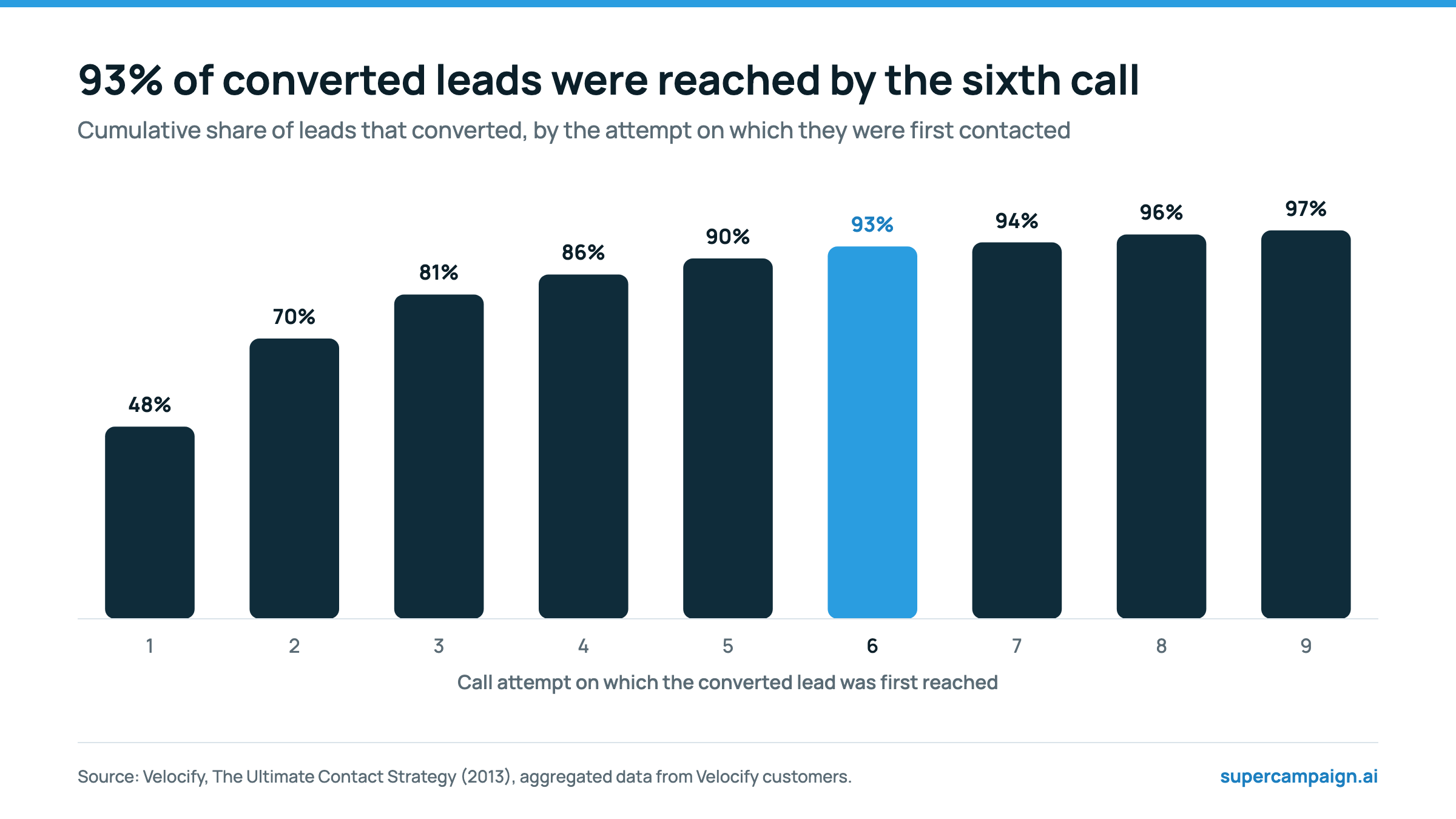
Two findings from the same study should change how most teams work. First, more than half of the leads that eventually converted were not reached on the first call, so a single attempt throws away most of your pipeline. Second, leads that needed seven or more calls to reach were almost half as likely to convert, so chasing past six attempts costs more than it returns.
The study is vendor research from 2013 and covers Velocify's own customers, so read the exact percentages as directional. The shape of the curve, steep at first and flat after six, is the useful part.
How far apart should call attempts be?
Front-load them. Most of the value is in the first day, while interest is fresh, and the rest spread out so the lead does not feel hounded.
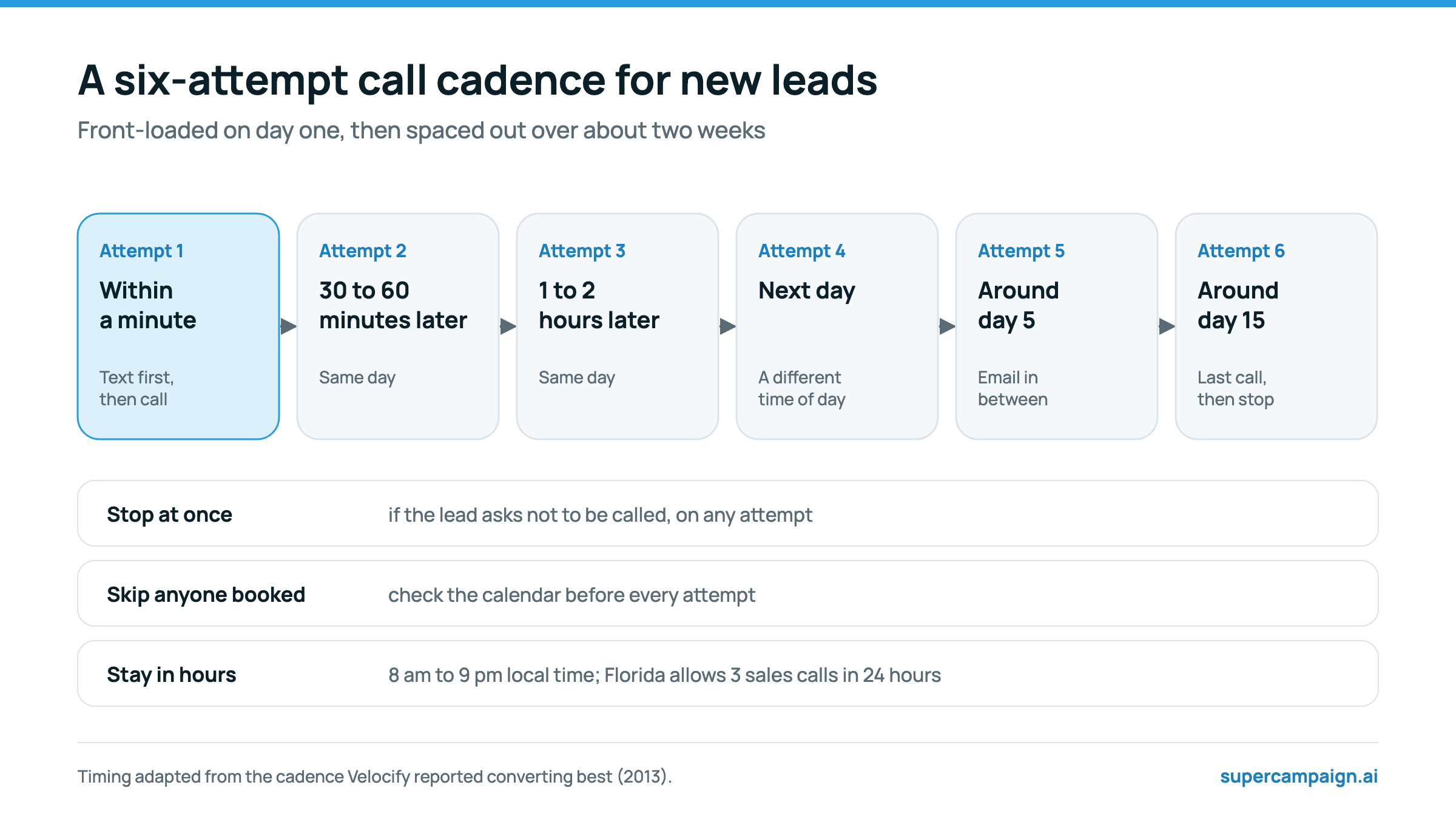
| Attempt | When, after the lead arrives | Alongside |
|---|---|---|
| 1 | Within a minute | A heads-up text just before the call |
| 2 | 30 to 60 minutes | Voicemail on this attempt |
| 3 | 1 to 2 hours | Nothing; keep it light |
| 4 | The next day, at a different time of day | A short email with a booking link |
| 5 | Around day 5 | A second email |
| 6 | Around day 15 | A final text, then stop |
Velocify found that the second attempt converted best when it came 30 to 60 minutes after the lead arrived, and that leads who received emails between call attempts were more likely to be reached by phone. Texts and emails also give people who will never pick up an unknown number a way to book themselves.
Before every attempt, check whether the lead has already booked, through the link in your text, for example. Calling someone who just booked is the fastest way to annoy a new customer.
What are the legal limits on when and how often you can call?
Speed and persistence both run into rules. In the United States:
- Calling hours. Federal rules allow marketing calls between 8 am and 9 pm in the called person's local time. A lead who arrives at 10:30 pm gets a text now and a call at 8 am their time.
- Daily caps in some states. Florida allows no more than three sales calls to the same person in 24 hours on the same subject, between 8 am and 8 pm. Three attempts on day one is the maximum for a Florida lead, and the fourth must come more than 24 hours after the first.
- Consent for automated and AI calls. Calls using an AI or prerecorded voice need the person's prior express written consent for marketing. A lead who filled in your form with a clear consent checkbox has given it.
- Opt-outs. If the lead asks you to stop, at any attempt, stop on every channel, and keep honouring it.
This is a summary, not legal advice. State rules vary; see Is AI cold calling legal? for more detail.
When should you stop calling a lead?
Stop when any one of these is true:
- You have made six attempts without a conversation.
- The lead has booked a meeting.
- The lead asked you not to call, by voice, text or email.
- The lead said not now and gave a time. Stop the cadence and call at that time instead.
Stopping does not mean losing the lead. Tag them, keep them in a nurture email sequence, and if they agreed to it, include them in a database reactivation campaign in a few months, when their situation may have changed.
What should each attempt say?
Repeat attempts should not sound like the first one. Change the angle each time so every contact gives the lead a new reason to respond.
- Attempt 1: what they asked for, and a question about it.
- Attempt 2 voicemail: a 15-second message saying you will text a link to book.
- Attempt 4 email: one useful thing, such as a price range, an example, or an answer to a common question, plus the booking link.
- Attempt 6: “I'll stop calling after this. If timing changes, here's the link.” People often respond to a clear last call.
How to automate a call cadence
A six-attempt cadence across two weeks, inside calling hours, skipping anyone who booked, is hard to run by hand for every lead. It is exactly what a workflow is for.
In SuperCampaign the cadence is drawn as a workflow: a heads-up text, a short wait, a check for an existing Calendly or iClosed booking, the AI call, then a loop counter and waits that bring the lead back to the booking check for the next attempt. Quiet hours hold calls until your calling window opens, and when a lead asks to be called at a particular time, the run waits and calls then. Anyone who asks the agent to stop is marked do-not-call and skipped by every future campaign.
Sources
Reviewed on 19 October 2026. Vendor figures are the vendor's own and have not been independently audited.